
Aurora, Ill., is Becoming a Post-Industrial Smart City. Is this an Urban Brand for the Future?
City of Big Shoulders.
The Motor City.
The Big Apple.
Gateway to the West.
Bean town.
Cities have nicknames, monikers for their je ne sais quoi, loved by locals and known by millions more.
Yet, I wasn’t in any of those big cities. I was in an ancient, storied space in my hometown of Aurora, Illinois, at an event called ThinkAI late 2025. While other cities may yearn to be a destination, speaker after speaker sketched Aurora’s destiny as a cybersecurity leader, a smart city, a model for our connected future.
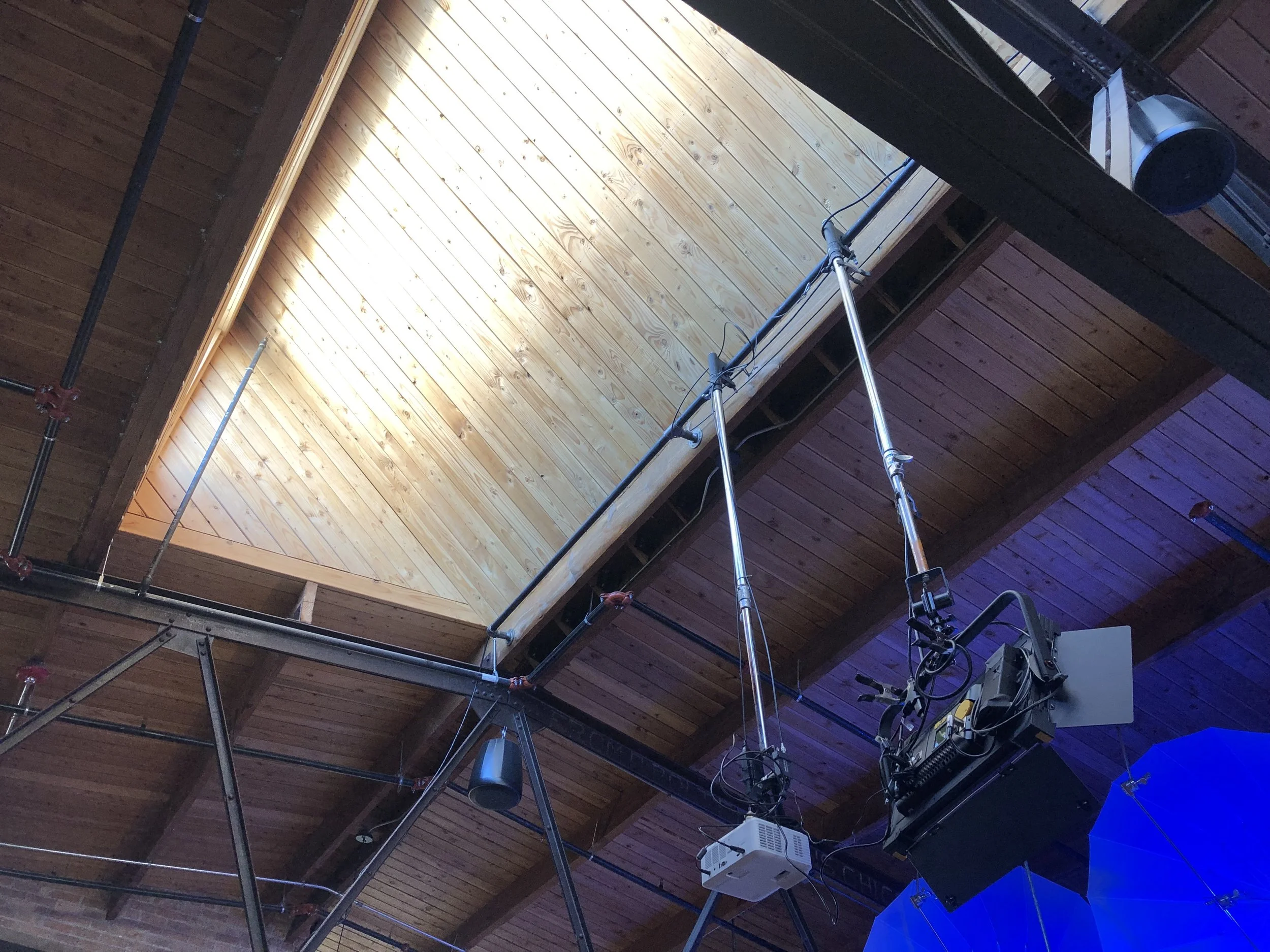
To understand this, all I had to do was look up.
History and modern coalesce.
What I saw: light streaming, dust dancing in its wake; portly I-beams set so cars could sit unencumbered by pillars a century ago; hardwood, everywhere, like a protective shell to a rare and wonderful idea. I’ve always connected better with the ghosts of the past than the sparkling people around me.
I sensed earnestness in this space. I felt energy. Where I stood, an ambitious salesperson once showed off a sporty Chalmers automobile (famed centerfielder Ty Cobb was a fan) or a high-brow Hudson with a “Super Six” 76 horsepower engine.
It was here, in this old-new building, I saw Aurora for who she was becoming, a post-industrial smart city being reconstructed from the same ambition that built the Coates Building I now was in, the “first automobile sales and service building built in the LaSalle Street Auto Row Historic District,” according to the city’s website.
Aurora, Illinois, population 180,710. Second largest city in Illinois. I run its ribbon of river trails. Walk its sidewalks, breaking free when my four walls stifle me. Breathe in books lined up like candy in our beloved library, a sanctuary to write in, a refuge to ponder in.
Then, suddenly, ThinkAI began. People were stirring, finding seats, grabbing that last cup of coffee. My heart beat a little faster. Open shelves spanned the length of the stage like a borderless curio cabinet filled with brilliant technology moments: a 35mm Leica camera, a boxy landline phone, a computer, a book.
Was this collage us? Were we innovations collecting dust and technology changing how we work and play? Do we stand upon the threshold of what once was and what is?
ThinkAI, hosted by TalkLab, was the first in a series of tech town halls under the same name. Think of it as an ongoing AI incubator-think tank-scribe-steward of sorts led by Jimi and Kate Allen.
The event opened with speaker Matt Mead, chief technology officer for SPR Consulting: “In a span of 90 years, electricity changed how we work, the internet changed how we connect, smartphones changed how we live. AI changes all three.”
OK, you’ve got my attention.
“Up until three years ago, everything ever written was written by a human,” he said. At this point, I was gulping air. Writers don’t like to hear their competition doesn’t sleep. Even so, Mead said that those highlighting the human component and automating mundane tasks will win. The best AI, he said, fades into the background so humanity shines. That’s better.
Then he talked about how data-driven smart cities will use predictive analytics, computer vision and sensors, large language models (LLMs) and Generative AI (GenAI) to win. The outcomes will be cities with efficient manufacturing companies, less power outages, safer working and living conditions, next-gen learning, increased revenues and outstanding customer experiences,
Chief AI Officer for Darwin AI Dustin Haisler, shared that 62% of employees are already using AI. “In the AI path,” he said, “we have moved beyond standalone AI, blown past embedded AI, outrun abstracted AI and are now standing at the threshold of Agentic AI where AI makes decisions and achieves goals.”
Mmmm. Nice. Can it decide to take five pounds off me and iron the tablecloth that’s been in the ironing basket for six months? Sorry, wrong metrics.
As for cities, there are high-stake goals, he said. AI is not another “tech wave.” Three areas he sees AI changing smart-driven cities:
Reshaping workforce, citizen services, investments, the innovation ecosystem, regional differentiation
Becoming a force multiplier
Accelerating innovation with the right governance
Case in point: AI helped a city in Pennsylvania save 95 minutes a day or 2 months of work per year. “Cities, businesses and people can’t do it alone,” he added. There’s a global race for AI, and it leads us to a merging, an alliance of sorts between humans and technology that becomes “general intelligence.”
Yet, I don’t eat Philly Cheesesteak or hang out in Independence Hall on a regular basis. Nope. I’m grabbing Italian at Giardinos or reading soldier letters at the Grand Army of the Republic Museum. I live in Aurora.
Almost overhearing my thoughts, the next speaker was the City of Aurora Chief Information Officer Ram Tyagi.
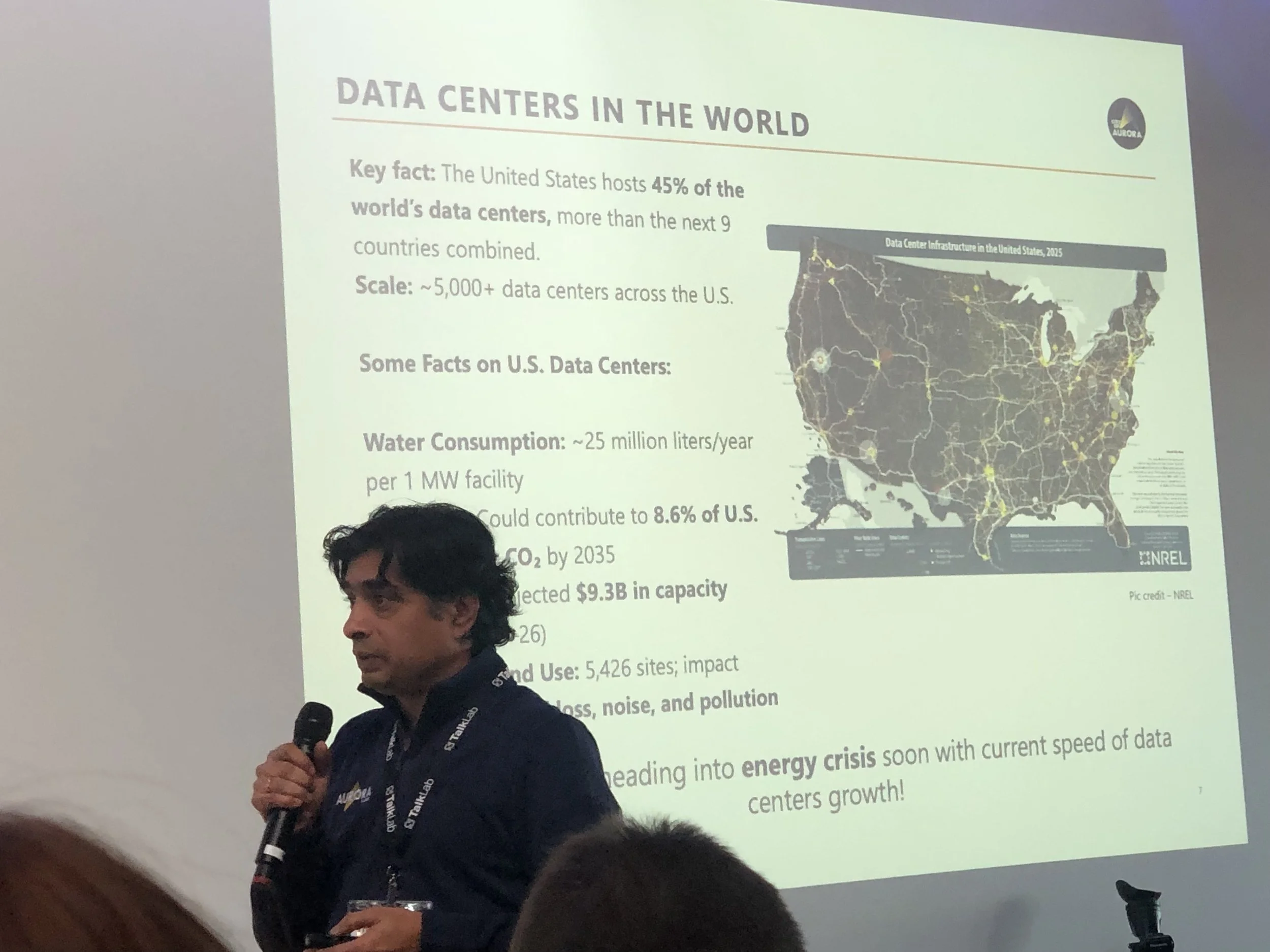
City of Aurora CIO, Ram Tyagi sees the future.
“Data is our most important asset, we need to activate it,” he said. “Unlock the potential of data. Data hides a lot of details.”
Out of the gate, he said without hesitation that Aurora will be a cybersecurity leader, a data-driven city, a leading hub for quantum technology and research. Big names, he said, like IBM, Google and Microsoft are investing in lightning-quick computational tech that most of us haven’t even learned much about. This is good news for those concerned about data center power consumption. Faster calculations use less energy.
AI, Tyagi says, is not a buzzword. Rather, “it is optimization with exponential benefits with policies and education in place.”
This CIO is crazy about data. Aurora is building a meta-data driven architecture to organize, track and govern data intelligently. In mere mortal terms, this means data becomes a single source of truth. More visibility, better compliance and more value creation leverages data, producing eyebrow-raising outcomes.
Aurora is readying itself to reap them:
Cost optimization
Effective measurement of KPIs
Operational efficiency
Transparency and collaboration
Jimi Allen, host, owner of the Coates Building, a gentleman I’ve known from a distance for many years, took the stage partway through ThinkAI.
He predicted one day, Optimus, a fully functional robot conceived by Elon Musk, will open up the cafe and serve us. We grabbed our box lunches. I wondered. When Optimus hands me a turkey club, what will I say? Thank you for lunch? My, you’re looking quite mercurial today?
Allen’s vision for Aurora bordered on poetic:
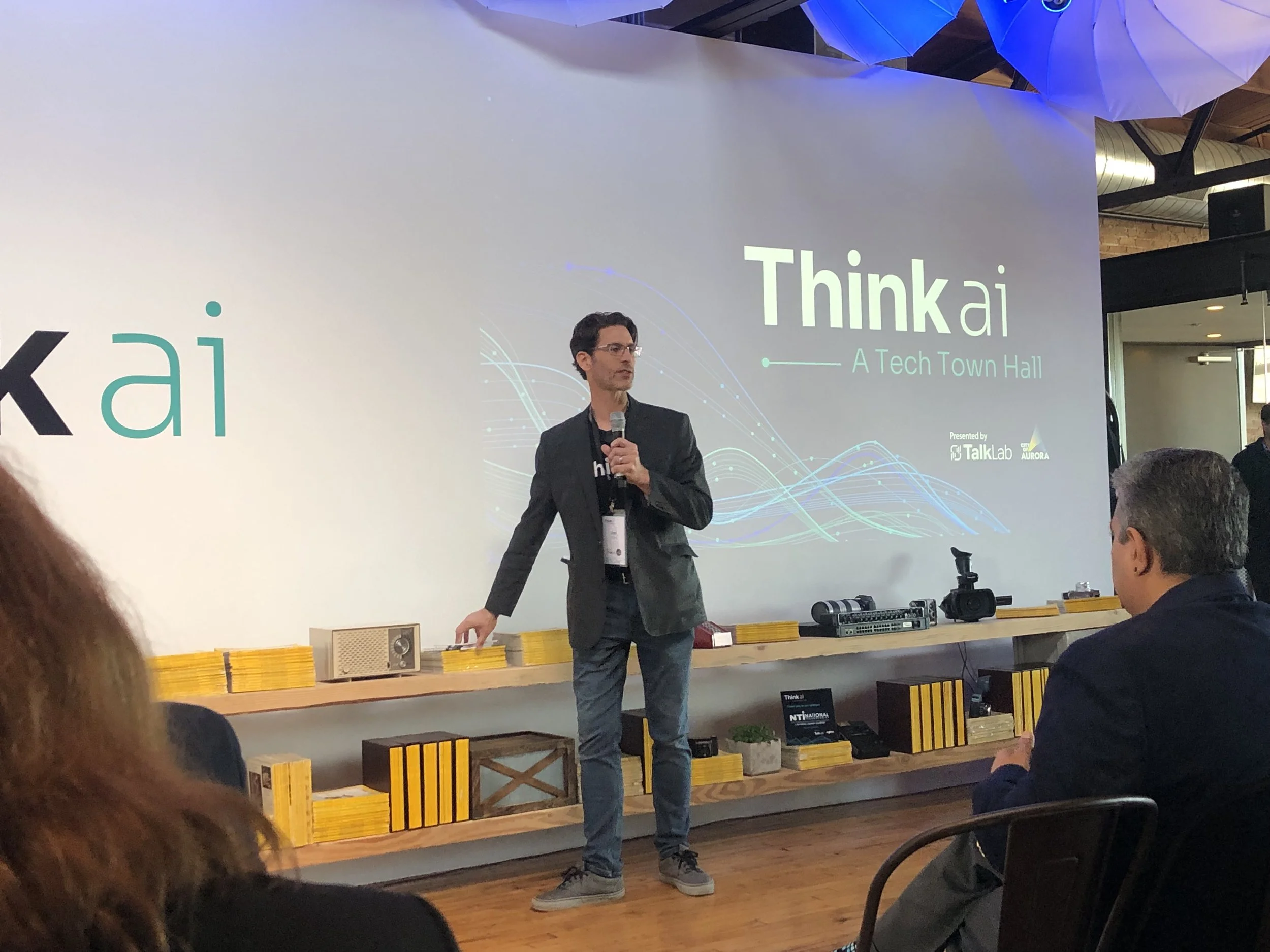
Jimi Allen of ThinkAI leads Aurora’s tech town hall.
Aurora is a place for pioneers, he said. Picture brilliant AI threads as disciplines, he said. Then he grabbed a book by philosopher René Descartes, a book that inspired him during college. All of us want to read it posthaste. Allen and his team are building an AI incubator named, like the event itself, ThinkAI. Like writers and artists Pablo Picasso, Ernest Hemingway and Dorothy Parker gathered in salons of years past, ThinkAI invites early adopters to cut a wide swath in a world where AI is embedded everywhere.
Then, Allen remembered the first time he captured something rare and wonderful with his camera. There was a change, he said. A change in the subject's eyes, like they had connected to who they really were, he said.
Most of us don’t look like this often. We hide. We armor up. I wonder what the world would look like if it was the other way around, if we revealed ourselves most of the time and if that revelation would be welcomed or eschewed. By our own selves.
Cogito, ergo sum. "I think, therefore I am" is a well-known quote from René Descartes' Meditations on First Philosophy. We exist.
Opening speaker Mead paid homage to our humanity, saying matter-of-factly: “AI does not have empathy.”
Ah, we have hearts. We have each other. We have our faith. These same qualities were more than enough a century ago when steely silver bumpers gleamed and customers waged the tradeoff of this car or that one. These same qualities, in turn, set the stage for an ambitious urban model, a post-industrial smart city that embraces its past, its people and the best of what it can be.
Aurora, point the way.