
Trade show season is off and running.
I’ve been to trade shows around the world and understand how much work goes into these events that deliver more steps in a day than we normally walk in a week. The planning, booth design and messaging begins shortly after the previous year’s event. Still, it almost always feels like we’re late to the game.
Manufacturing companies use trade shows to invite a steady stream of visitors that, hopefully, turn into “warm” leads. In marketing speak, that means people who are apt to buy your products.
A trade show, though, is more than a numbers game.
An Aligned Story is Your Secret Sauce
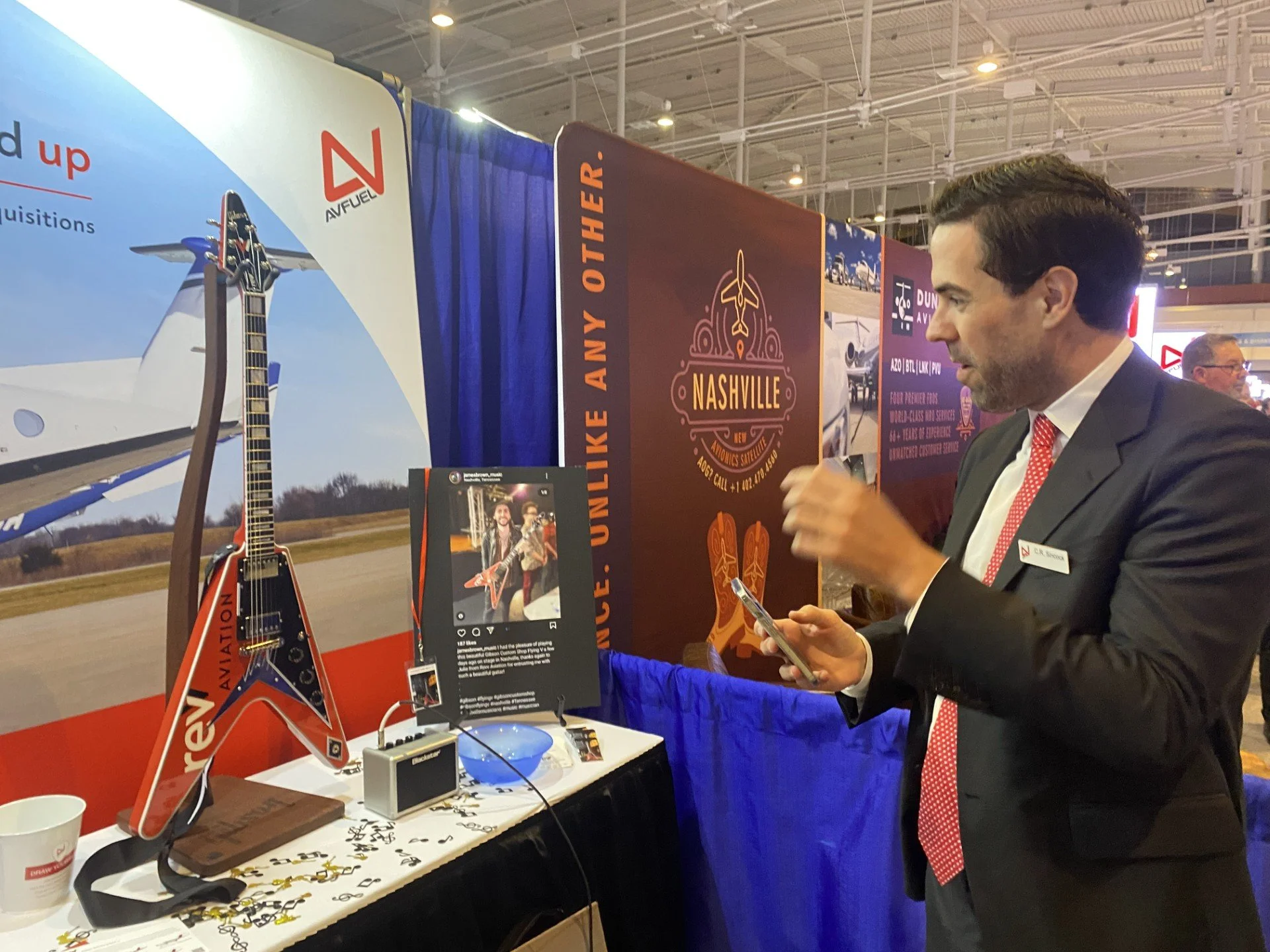
Avfuel President C.R. Sincock inspects the Revv custom guitar that was raffled off at NBAA in Nashville .
I could tell you what a unified story looks like, or I can show you. The second is much more fun. Allow me to teletransport back to the early 2000s when I was on the PR team for one of Motorola’s least loved divisions: infrastructure. Motorola always had a very large presence located prominently on the floor of all the major telecommunication tradeshows.
Our biggest challenge? Controlling the internal push-pull when it came to product placement inside the booth. And, no, it wasn’t because people were clamoring to talk to me about base stations.
It was more like a trip to Disney with your kids.
We had the popular cell phones that typically garnered the heaviest traffic and attention (popular child who always has weekend plans). We also had the land-mobile-radio division featuring emergency responder radios for police and fire (pragmatic child who brings a little, red first aid kit on trips). We had rugged two-way Nextel iDEN radios that sought to elbow its way to the center (this one is the intellectual child who doesn’t study and is criticized by siblings for earning straight As). And then there was the infrastructure division, which I was in, that was the red-headed stepchild (they are a little behind the others, but will catch up later in life tenfold).
None of the featured phones and radios in our company would work without the base stations. Our boxes were not sexy, but our technology was extremely important if those devices were to optimally operate. Each Motorola division and product had its own story. Add the fact that our executives (not the ones I did PR for) were interviewed on the state of the cellular industry and whatever hot new product we were hyping.
Yet, we didn't have a unified story. Each person in the booth operated in a silo. Cross-messaging was rarely shared with booth staff. If someone were to ask me about the latest phone, I'd take them over to someone in the cell phone division. If someone asked me what made Motorola different, I’d give them to corporate PR.
Yes, that was a Global 100 company. Size doesn't matter, though, when it comes to a unified story. If you have five employees or if you have 50,000, when one, unified story is known across departments and technologies, your brand stands out.
A culture of consensus gives you a power position because your messaging is stronger, clearer and more focused.
This is where you get people talking . . .
Cue the Buzz
Events, like IMTS2026 this September or FABTECH 2026 in October, are golden opportunities to access a referenceable market, one that is all in one place, over a series of days, doing something amazing: They are talking.
To this point, hopefully, people are talking about your company.
Thinking of your audience as a referenceable market can be an underestimated strategy. According to the book Crossing the Chasm, a referenceable market is a defined niche or beachhead to dominate within an early majority market. A referenceable market is a milestone on the road to the mainstream market where peers use your products and trusted, word-of-mouth conversations put you on the short list.
In a blog on trade show statistics by vFairs, an events management platform, Tamar Beck, CEO and co-founder of Gleanin puts it this way: “Experiences people talk about are more valuable than big ad budgets; organic buzz can outlast the show floor.”
We agree.
At trade shows, people get to know you and talk to others who already know you so they believe in you. Creating believers outcompetes a metric, like the number of scanned badges, any day of the week.
Trade shows give you an opportunity for people to get to know you and talk to others who already know you so that they believe in you.
Let’s talk about believers next: why they are important and how to inspire them.
Believers, Not Just Booth Visitors
In the book “The Story Factor,” author Annette Simmons writes: “People don’t want more information. They are up to their eyeballs in information. They want faith – faith in you, your goals, your success, the story you tell them.”
Giving people a reason to believe in your manufacturing company, your team and your solutions makes your brand unforgettable.
Giving people a reason to believe in your manufacturing company, your team and your solutions makes your brand unforgettable.
\It's a different viewpoint on customers. So often, the verbiage is "go after new customers" or "move targets through the sales funnel" or “get them in the booth.” There are all kinds of militaristic terms in marketing: target market, guerilla marketing, campaign blitz, the battle for marketshare (give me a few more minutes and I could keep on going!).
Yet, what happens when we take a slightly different view? What if people understand you through your authentic stories? What does it look like when customers and prospects actually believe in you?
A referenceable market scales as people say, “Have you heard about ABC Manufacturing Company? They’ve got a cool widget in their booth to demonstrate their latest tech that accelerates concrete curing by 70% through 3D printing.” (Said quote is completely a made-up example for the purposes of our conversation here.)
Now, let’s say your team all knows and understands this new technology, but do they know the origin story of how this technology evolved? Because you have several patents and an innovation center within your company. Because you invest in R&D because the founder advocates for always bringing what’s next to your customers. Because one of your company values is “Learn with your customers by your side” so you’ve beta tested the concept in an agile framework that allows for continuous updates so your customer succeeds in business through innovation – with you by their side.
One, Unified Story Builds a Culture of Consensus
Craft a unified story that stands out. Share it with your team in both a meeting where they can role play and ask questions. Give them a cheat sheet and connect a unified story with outcomes and goals you want from the trade show.
An aligned story builds a culture of consensus – before people board planes or cars for the event.
We can all agree that it’s essential to have a strong product demo that is part of your company’s story. But there are equally important elements beyond product spec sheets alone. Think of your event like a book:
Booth messaging is the title of your story
The video loop cites the proof points for your story
Slick sheets add clarity to your story
The sales team delivers confidence and flow driving your story
Media/analyst executive interviews show industry thought leadership; they are the testimonials behind your story
When these elements align, something interesting happens.
A unified story allows prospects to stop trying to figure out who you are and what you do and start figuring out how to work with you.
Trade shows reward the most unified and coherent story.